By Addison Parker – Partner at Fortis Accounting Solutions
Have you ever opened a monthly report from your accountant, looked at the rows of numbers, and felt a quiet wave of confusion or even embarrassment?
You aren’t alone. Many successful founders feel like they are “supposed to know” what these documents mean, so they nod along during meetings while secretly wondering if their business is actually healthy or just busy. At Fortis Accounting Solutions, we believe your reports shouldn’t be intimidating; they should be the “financial GPS” that helps you grow with confidence.
Let’s strip away the jargon and look at the three core reports using a real-world example from a Seattle-based design studio.
1. The Profit and Loss Statement (P&L): Your “Scorecard”
The P&L shows your revenue, costs, and profit over a specific window of time (like a month or a year). It answers the most basic question:
Did we make money?
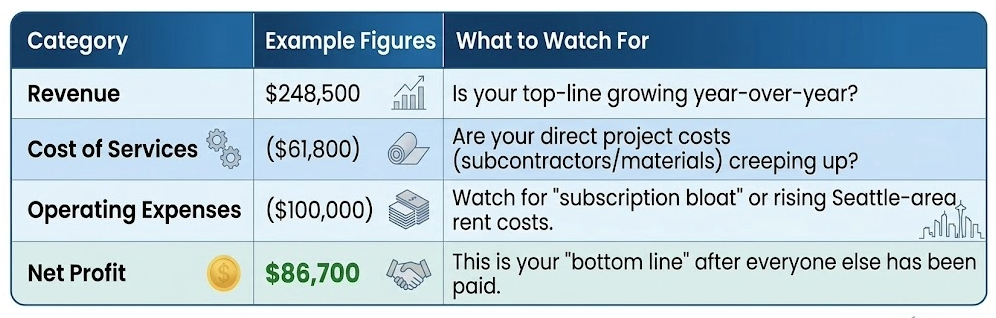
The Professional Tip: In 2026, don’t just look at the total. Compare your Gross Profit Margin (Gross Profit ÷ Revenue) to your industry average. If it’s dipping, your pricing might need an update.
2. The Balance Sheet: Your “Snapshot”
Unlike the P&L, which covers a period of time, the Balance Sheet is a photo of a single moment (usually the last day of the month). It shows what you own (Assets) versus what you owe (Liabilities).
- Assets ($69,700): This includes your bank balance, equipment, and “Accounts Receivable” (money clients owe you).
- Liabilities ($6,700): Credit card balances, loans, and local taxes like the Washington B&O tax you’ve set aside.
- Owner’s Equity ($63,000): This is the “book value” of your business.
The Professional Tip: Check your Current Ratio (Current Assets ÷ Current Liabilities). If it’s below 1.0, you might struggle to pay your bills next month, even if your P&L says you’re profitable.
3. The Cash Flow Statement: The “Reality Check”
This is often the most eye-opening report. Profit is an accounting concept; Cash is a reality. This report tracks the actual dollars moving in and out of your bank account.
- Operating Cash ($94,300): The actual cash generated by your day-to-day work.
- Investing/Financing (-$42,500): Cash spent on new computers or taken out as “Owner Draws.”
- Net Increase ($51,800): The actual change in your bank balance.
The Professional Tip: If your P&L shows a profit but your bank account is empty, your Cash Flow statement will tell you why. Often, it’s because cash is “trapped” in unpaid client invoices (Accounts Receivable).
At the end of the day, your financial reports are more than just columns of numbers. They’re the story of your hard work and your business’s potential. If looking at these statements still feels like reading a foreign language, don’t worry. Our mission at Fortis Accounting Solutions is to be your translator. We handle the technical heavy lifting so you can stop guessing and start leading with clarity. We are always standing by to help turn your ‘fuzzy’ numbers into a clear roadmap for growth.
Outsourced Accounting for Growing Businesses
Our mission is to equip business owners and decision makers with the information that they need to make great decisions for themselves and their employees. As fellow small business owners, we know how busy things can be and how helpful it is to be able to feel confident in your finances when making important decisions.
Don’t navigate the complexities of small business accounting alone. Join the successful business owners who trust Fortis Accounting Solutions for expert guidance and precision bookkeeping.
Schedule Your Free Consultation Today!
Glossary: Key Terms for the Non-Accountant
Even if you’ve been in business for years, these terms can be slippery. Here is a simple guide to what they really mean for your business.
Accounts Payable (AP) The money your business owes to others. Think of this as your “unpaid bills” folder. This includes things like your next month’s rent, utility bills you haven’t paid yet, or invoices from subcontractors.
Accounts Receivable (AR) The money that is owed to you by your clients. On your Balance Sheet, this is considered an asset because it is cash that is expected to arrive soon. If this number is too high, it usually means you need to tighten up your collections process.
Accrual vs. Cash Accounting
- Cash Basis: You record income when the money hits your bank and expenses when you pay them. It’s simple but can be misleading.
- Accrual Basis: You record income when you earn it (even if the client hasn’t paid yet) and expenses when you incur them. Most professional firms in 2026 use Accrual because it gives a much more accurate picture of long-term health.
Chart of Accounts (COA) The organizational backbone of your bookkeeping. It is essentially the “index” of all the categories where your money goes (e.g., Marketing, Travel, Rent). A clean COA makes your reports easy to read.
Depreciation A way of spreading the cost of a big purchase (like a $5,000 MacBook or a studio van) over its useful life rather than taking the whole hit in one month. It shows up as an expense on your P&L even though no actual cash left your pocket that month.
Equity (Owner’s Equity) The value that would be left in the business if you sold all your assets and paid off all your debts. It’s your “stake” in the company.
Net vs. Gross Profit
- Gross Profit: What’s left after paying for the direct costs of your work (like the subcontractors you hired for a specific project).
- Net Profit: What’s left at the very end after all bills, taxes, and overhead are paid. This is your “take-home” profit.
Reconciliation The process of cross-referencing your bookkeeping software against your actual bank statements to ensure they match perfectly. If they don’t match, your reports are essentially guesses.
